
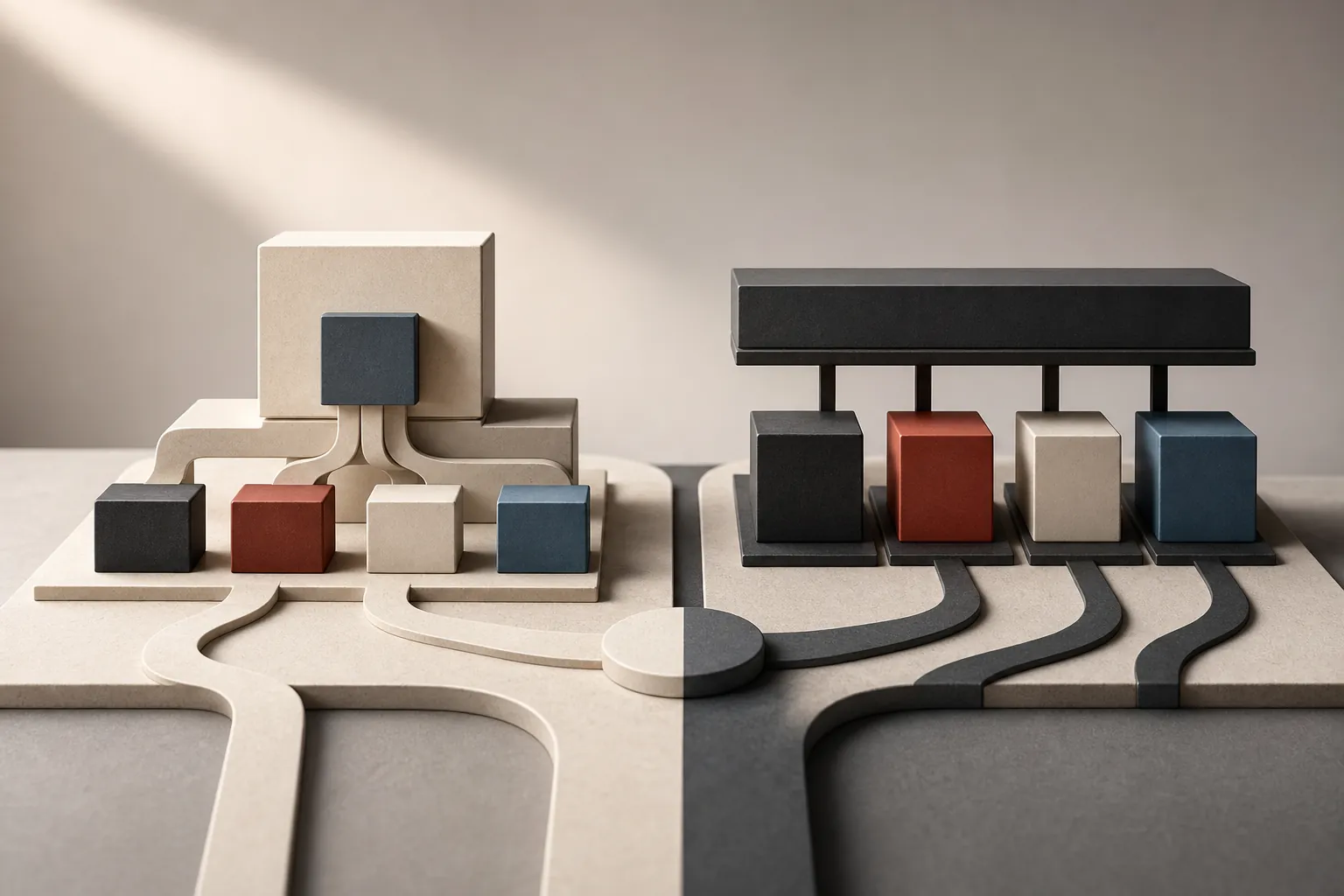
Branded house vs house of brands is not a logo debate. It is a decision about how much trust, memory, risk, and investment should be shared across a company's offers. One system concentrates attention behind a parent brand. The other lets separate brands build their own meaning. Both can work. Both can become expensive nonsense when the model follows internal politics instead of the customer's buying decision.
A branded house uses one main brand to carry most of the portfolio. A house of brands gives individual brands more independence, often with the parent company sitting quietly in the background. Hinge describes the basic split clearly: in a branded house, the firm is the brand; in a house of brands, the emphasis moves to the subsidiary brands rather than the parent: Hinge on brand strategy models.
The useful question is not which model looks cleaner. It is which model makes the market easier to navigate. kgb has built and backed brands where public memory mattered: 118 118, 118 218, 1818, 118 118 Money, Conduit Global, and Dispo. Those brands did not all need the same relationship to the parent company. Some needed their own name to win a market. Some benefited from a wider operating story. The model should follow that reality.
Start with what the customer needs to understand
A brand architecture decision should start outside the company. What does the customer need to understand quickly? Are they choosing between similar offers from one trusted company, or are they choosing between different brands that solve different problems? Does the parent name reduce doubt, or does it distract from the specialist promise?
If customers already trust the parent and the offers share a promise, a branded house can make buying simpler. The parent name acts as a shortcut. The customer does not need to relearn credibility from zero every time a new offer appears. That can make sense for a company with related products, shared standards, and a reputation that genuinely transfers.
If the offers serve different audiences, categories, price points, or emotional jobs, a house of brands may be clearer. The customer can meet each brand on its own terms. That is especially useful when one parent story would flatten the differences customers actually care about.
| Question | Branded house points to | House of brands points to |
|---|---|---|
| Do the offers share one promise? | Yes, the parent promise makes the portfolio clearer. | No, separate promises need room to breathe. |
| Does parent trust help the sale? | Yes, visible association reduces risk. | No, the child brand needs its own credibility. |
| Are customers and occasions similar? | Yes, one memory system can work harder. | No, each audience needs a distinct brand world. |
| Would one failure hurt everything? | The risk is acceptable or manageable. | Separation protects the wider portfolio. |
| Can every brand be properly funded? | No, concentrate investment behind one name. | Yes, each brand can earn memory independently. |
Use a branded house when trust should compound
A branded house is strongest when the parent brand has equity that can help every offer. It concentrates media, design, search demand, customer service standards, and reputation behind one memory structure. Google's public product directory is a familiar example of a parent name supporting many related products and services: Google products.
The advantage is efficiency. One brand gets repeated more often. New offers can borrow familiarity. Customers can move across the portfolio without wondering whether the company has changed standards. That matters when the parent promise is narrow enough to stay useful and broad enough to support growth.
The danger is stretch. A parent name can become a lazy umbrella for offers that do not belong together. When everything carries the same name, one bad experience can leak across the portfolio. The Brand Consultancy notes that a branded house centralizes equity and tends to be more efficient, but it also increases shared reputation exposure: The Brand Consultancy on model tradeoffs.
Use a house of brands when separation creates clearer choice
A house of brands is strongest when different brands need different meanings. The parent may own the portfolio, but customers primarily choose the individual brands. Procter & Gamble's official brand directory shows the logic clearly: Pampers, Tide, Gillette, Crest, and other brands serve different needs under a larger company: P&G brands.
The advantage is precision. Each brand can have its own audience, cues, promise, price position, and distribution strategy. That can help a company cover multiple buying moments without asking one name to mean too many things. It can also protect the portfolio when one brand carries a risk that should not transfer.
The cost is real. Each independent brand needs management, creative discipline, customer experience standards, measurement, and enough repeated exposure to be remembered. A house of brands is not a neat folder system. It is a commitment to fund multiple memory systems. If the company cannot do that, independence becomes underinvestment with a prettier name.
Do not ignore the hybrid option
Many companies are neither a pure branded house nor a pure house of brands. They use a hybrid system: some offers share the parent name, some are endorsed, and some operate independently. Franke+Fiorella describes the middle ground as a way to combine parent-brand strength with specialist sub-brand distinction: Franke+Fiorella on hybrid architecture.
Hybrid systems are useful when the portfolio contains brands with different levels of customer memory. A newer offer may need visible endorsement. A mature acquired brand may need independence. A product line may fit cleanly under the parent. The trick is not to call everything hybrid and move on. That is not strategy. That is fog with a diagram.
A good hybrid system has rules. When does the parent come forward? When does it stay quiet? Which brands can borrow trust? Which brands should be protected from each other? If the rule cannot be explained in plain language, customers will probably feel the confusion before the company admits it.
Make the decision with evidence, not preference
The easiest way to choose badly is to ask executives which model they personally prefer. Personal taste will overvalue neatness, legacy, or the latest rebrand. Evidence is less glamorous and more useful. Start with customer research: can people explain what each brand is for? Do they know the parent? Does the parent add confidence? Do separate brands feel meaningfully different?
Then look at behavior. Branded search, direct traffic, repeat purchase, sales-call language, support questions, conversion quality, referral patterns, and category-entry point strength all show whether the current system is helping or slowing people down. The site's guide to brand tracking goes deeper on measuring memory and consideration over time.
Finally, look at economics. A house of brands may be strategically right, but only if the business can support each brand properly. A branded house may be efficient, but only if the parent promise can stretch without becoming vague. Architecture is not a drawing. It is an investment plan.
Watch the warning signs before the system breaks
Brand systems usually fail quietly before they fail publicly. Sales teams start explaining the portfolio differently. Customers ask whether two brands are connected. Marketing budgets get split across names that should be building one memory. New launches ask for new brands because nobody wants to do the harder work of prioritizing.
Another warning sign is duplicated meaning. If two brands serve the same buyer, same need, same price point, and same proof, they may be competing with each other instead of the market. The opposite problem is underlap: a growing customer need is not clearly served by any brand. Both problems show why brand portfolio strategy needs to sit beside brand architecture.
The most expensive warning sign is misplaced risk. If a high-risk offer shares too much visible identity with the parent, one problem can damage unrelated parts of the company. If a high-trust parent stays invisible when reassurance would help, the business wastes credibility it already owns. The right model decides where trust should travel and where it should stop.
Apply the model to the website and buying path
The website is where brand architecture becomes obvious or painfully vague. Navigation, portfolio pages, product pages, blog categories, case studies, and contact paths all teach visitors how the brand system works. If the architecture is clear in a board deck but confusing on the website, it is not clear enough.
kgb's site gives a visitor several connected proof paths: the company story, the operating philosophy, the portfolio, and the 118 118 TV archive. Those paths help a founder see both the parent company and the brands that built public memory in their own markets.
That is the commercial point. Architecture should help a buyer move from understanding to confidence. It should make the next click clearer, not force the visitor to decode a corporate family tree before deciding whether the company can help.
How kgb thinks about the choice
kgb's bias is that brands deserve independence only when independence helps customers choose or helps the business protect trust. A separate brand should have a job, a real audience, a memory system, and enough support to become more than a name. A parent brand should come forward when its proof makes the decision safer and clearer.
The stronger brand system is not always the one with fewer names. It is the one where every name earns its place. Sometimes that means concentrating attention behind a parent. Sometimes it means protecting a specialist brand's distinct meaning. Sometimes it means using endorsement so trust transfers carefully instead of messily.
If the current question is whether to unify, separate, endorse, or retire brands, start with the buying moment. What does the customer need to remember? What proof already exists? Where does risk belong? Where will investment actually be repeated? The model that answers those questions with the least friction is usually the one worth building.
Branded house vs house of brands FAQ
What is the difference between a branded house and a house of brands?
A branded house uses one main parent brand across offers, while a house of brands lets separate brands stand on their own. The right model depends on whether customer trust, audience overlap, operating risk, and marketing investment work better together or apart.
When should a company use a branded house?
Use a branded house when the parent brand is trusted, the offers share a similar audience or promise, and one clear memory system will make buying easier. It is strongest when the parent reputation can help each offer rather than stretch too far.
When should a company use a house of brands?
Use a house of brands when different brands need different audiences, price positions, category meanings, or risk boundaries. It can protect flexibility, but each brand needs enough investment to earn memory on its own.
Can a company use a hybrid brand architecture?
Yes. Many companies use a hybrid system where some brands share the parent name, some are endorsed by it, and others stay independent. A hybrid works when each relationship is clear to customers and not just convenient for the company.
Build the right brand system
See how kgb has built distinct brands without losing the bigger operating story.
View the portfolioRelated posts
Keep building the system
 Brand Portfolio Strategy: Know What to Keep Separate
Use brand portfolio strategy to decide which brands to grow, combine, separate, retire, or protect as the business scales.
Brand Architecture: Make the Portfolio Easier to ChooseUse brand architecture to decide when brands should stand alone, share trust, or stay inside one clear system.
 Brand Preference: Make Choice Feel Easier
Build brand preference by reducing choice friction with memory, proof, availability, experience, and trust customers can repeat.